
AI is changing job tasks faster than most career plans can keep up. The upside is real: new roles, higher leverage, and better tools. The downside is also real: sudden task automation, shifting hiring signals, and skills that age out quickly. The most useful response isn’t panic or denial—it’s building a career that can bend without breaking as tools evolve. For more guidance, see Artificial Intelligence and Employment: New Cross-Country Evidence.
Instead of betting everything on a single job title staying stable, focus on what actually changes first: the tasks inside the job. When you can spot which tasks are becoming “software by default,” you can reposition toward the work that still benefits from judgment, context, and ownership. For further reading, see How not to lose your job to AI | 80,000 Hours.
Work is made of tasks, and AI tends to replace or reshape tasks before it replaces entire job titles. That’s why two people with the same title can have very different exposure: one might spend most of the week drafting, summarizing, and routing requests; the other might spend it aligning stakeholders, diagnosing root causes, and making decisions with imperfect information.
Many teams won’t announce “AI transformed this job.” They’ll quietly raise expectations: faster turnaround, fewer manual steps, cleaner documentation, and more proactive recommendations.
AI job growth often shows up in the “glue work” that makes automation safe, scalable, and measurable. The fastest-growing opportunities tend to sit at the intersection of people, process, and systems—especially in regulated or high-stakes environments.
| Task type | Typical AI effect | Safer move |
|---|---|---|
| Repeatable text processing (summaries, basic emails) | Drafting becomes instant; quality control becomes key | Own review standards, tone, and stakeholder alignment |
| Routine analysis (dashboards, variance notes) | Faster insights; less tolerance for manual steps | Shift to framing questions, decision support, and experimentation |
| Customer interactions (tier-1 support) | Deflection and auto-replies increase | Move up to escalations, retention, and workflow improvements |
| Creative production (simple variants) | Volume increases; differentiation becomes harder | Specialize in strategy, audience insight, and brand consistency |
| Operations coordination (scheduling, tickets) | Automation reduces manual follow-ups | Own process design, SLA performance, and cross-team systems |
For broader context on how organizations expect work to shift, see the World Economic Forum’s Future of Jobs Report and research summaries from the OECD on AI, automation, and work.
A quick way to evaluate risk is to estimate how time is spent in the role. Start with a rough split and adjust:
If repeatable execution is above ~50%, the priority is to redesign workflows and acquire a higher-level specialty. If judgment/coordination is the bulk of the job, the opportunity is to scale impact through tools and measurement (SOPs, KPIs, QA, experiments). If strategy/problem framing is already strong, add technical fluency so you can prototype solutions and communicate tradeoffs clearly.
| Milestone | Deliverable | Proof |
|---|---|---|
| Task inventory complete | Task map + time estimates | Baseline cycle time and error rate |
| Workflow 1 improved | SOP + templates + QA rubric | Time saved and quality audit |
| Workflow 2 improved | Automation + monitoring plan | Trend metrics over 2–4 weeks |
| Portfolio-ready narrative | 1–2 case studies | Before/after charts and stakeholder feedback |
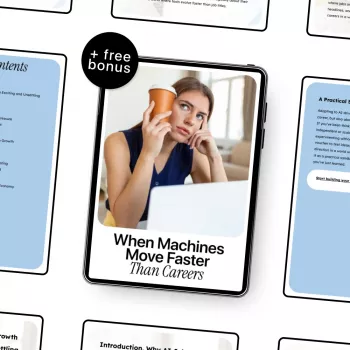
If a concise, actionable framework would help, consider: When Machines Move Faster Than Careers | Practical Guide to Navigating AI Job Growth Risks & Future-Proof Skills.
For building the habits that support long-term performance while learning new workflows, some readers also pair career upgrades with practical home routines and comfort essentials such as the Luxury 70″ Fluted Fireplace TV Stand for a focused space, or wardrobe staples like Brunello Cucinelli Men’s Cotton Denim Pants for day-to-day polish.
Roles dominated by repeatable, task-heavy work are most exposed—especially where the output is text, templates, routing, or routine analysis. Most jobs evolve before they disappear, so the practical move is to map your tasks and shift toward judgment, coordination, and strategy.
Skills that age slowly include problem framing, domain expertise, systems thinking, communication under uncertainty, measurement, and AI evaluation/governance. These skills help you define quality, reduce risk, and drive outcomes even as tools change.
Pick one workflow, compress it with AI plus process changes, measure results, and document a short case study. Expand to a second workflow and keep building a portfolio of measurable improvements you can show in interviews or internal reviews.






Leave a comment