
Confident leadership is rarely about charisma; it is built on repeatable behaviors that teams can trust. A leadership traits checklist turns “be a better leader” into clear, observable actions—so strengths can be doubled down on and gaps can be addressed without guesswork. This guide breaks down the traits that most strongly shape credibility, decision quality, and culture, then shows how to use a simple checklist rhythm to lead with clarity, consistency, and purpose.
Teams don’t experience leadership as a personal brand—they experience it as a pattern. “Leading like you mean it” shows up in the unglamorous moments: how priorities are set, how decisions are explained, and what happens when things go sideways.
Trust is the multiplier. When people trust the leader, they move faster, speak up sooner, and spend less energy protecting themselves. That dynamic is supported by well-documented leadership fundamentals, including trust and credibility-building behaviors (see the American Psychological Association’s overview of trust in leadership and research summarized by Harvard Business Review).
Traits get traction when they’re translated into behaviors a team can actually notice. The goal isn’t to “score your personality”—it’s to build a repeatable operating system for leadership.
| Trait | Behavior to practice | What it sounds/looks like | Common pitfall |
|---|---|---|---|
| Clarity | Name the top priority and what can wait | “This week, the only must-win is X; Y is paused.” | Everything stays “urgent,” so nothing is truly prioritized |
| Accountability | Close loops on commitments | “Here’s what shipped, what slipped, and the new date.” | Avoiding updates until asked |
| Courage | Address misalignment early | “Something feels off—can we surface assumptions?” | Letting resentment build until it explodes |
| Empathy | Ask about constraints, then set a standard | “What’s blocking you? Let’s remove it—deadline stays Friday.” | Confusing empathy with lowering expectations |
| Decision quality | State criteria and trade-offs | “We’re optimizing for speed over polish due to X.” | Decisions feel random or political |
Presence isn’t about volume or bravado. It’s the calm signal that you’re oriented, prepared, and committed to the outcome—especially when conditions are messy.
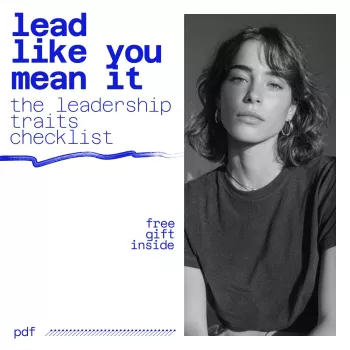
If a structured, reusable format would make weekly leadership improvement easier to maintain, Lead Like You Mean It: The Leadership Traits Checklist is designed to keep the focus on behaviors, not vibes. It’s best for leaders who want a repeatable way to assess strengths, spot blind spots, and improve week by week.
A checklist focuses on observable behaviors and repeatable habits in real work situations, not fixed identity labels. It’s most useful when it measures frequency and consistency—what happens in meetings, decisions, and follow-through—so change is straightforward.
A weekly 10-minute review with one micro-commitment is enough to create noticeable improvement over time. Small changes compound because they’re easier to practice consistently than occasional major overhauls.
Yes—when the language stays behavior-based, definitions are shared, and the goal is development rather than evaluation. Start with optional self-scoring, then discuss specific examples and one next-step behavior, not personal traits.





Leave a comment